
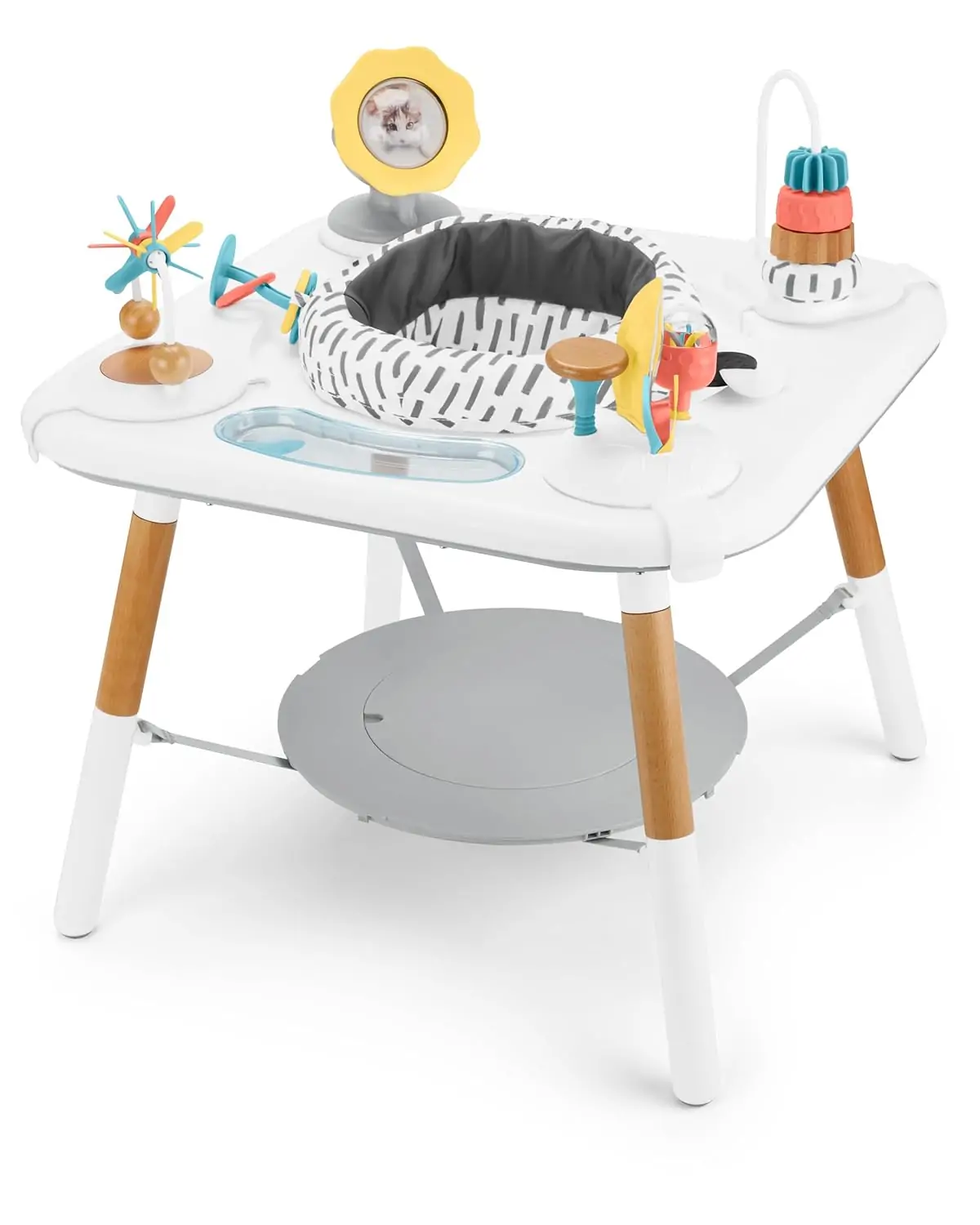
Skip Hop Discoverosity Montessori-Inspired 3-Stage Activity Center & Play Table for Baby Ages 4m+
- Montessori-inspired design supports self-directed sensory play from 4 months and up
- 5 moveable toys and 25+ activities create a more flexible play setup
- Discovery Window™ helps baby see movement and learn simple cause and effect
- 360-degree rotating seat keeps toys within easy reach from every side
- 3-stage design grows from seated play to cruising and toddler table use
- Natural wood accents give it a calmer and more furniture-friendly look
A More Thoughtful Way to Support Early Play and Discovery
Baby gear often does one job for one short stage. Then it starts to feel bulky, noisy, or easy to outgrow.
The Skip Hop Discoverosity feels more refined from the start. It is playful, but not chaotic. It is designed for babies, yet it also feels easier to picture as part of a real living space.
The balance is what makes it stand out. Instead of relying on an overly busy setup, it creates a calmer kind of play experience built around movement, touch, and simple discovery. There is plenty for babies to explore, but the overall feel is softer and more thoughtful.
For parents, it means a real difference. You get a product that keeps the baby engaged, looks more pulled together at home, and feels like it was designed with longer everyday use in mind.
Technical Specifications
- Recommended age: 4 months+
- Use stages: Sit, swivel & play; Cruise & interact; Play table
- Developmental activities: 25+ activities
- Moveable toys: 5 Montessori-inspired toys
- Seat type: 360-degree rotating seat
- Foot support: Adjustable foot platform
- Base stability: Non-skid feet
- Weight capacity: Up to 25 lb / 11.3 kg
- Product dimensions: 25.25″ L × 25.25″ W × 27.25″ H
- Materials/detailing: Sustainably-sourced natural wood accents
Montessori-Inspired Learning
Among Skip Hop’s three-stage activity centers, Discoverosity feels like the most intentional shift in play style. Explore & More and Silver Lining Cloud still center more on classic baby activity center play, with brighter themed toys, musical features, and a more familiar high-stimulation setup. Discoverosity keeps the same three-stage format, rotating seat, and Discovery Window™ foundation, but its overall direction is different. It was developed as part of Skip Hop’s Montessori-inspired Discoverosity line and takes a quieter, more hands-on approach to play.
Instead of feeling packed with random stimulation, Discoverosity is built around the idea that babies learn by reaching, touching, turning, watching, and trying again. Skip Hop developed this activity center with Montessori education experts and describes it as a space for self-directed exploration and sensory engagement, which fits the product very well.
You can see that approach in the way the play experience is set up. The toys are moveable rather than locked into one fixed layout, so the setup can shift with a baby’s abilities. The activities also lean into simple interaction instead of flashy distraction. There are pieces designed for self-recognition, tactile exploration, grasping, batting, and hand-eye coordination, including the rotating mirror, wooden rings, soft sensory materials, movable beads, and other parts that reward touch and movement.
All details make the product more purposeful in everyday use. A baby is not just sitting in the middle of noise and color. The design invites the child to do something, notice what happens, and stay engaged through repetition. That creates a calmer style of play, and it also makes the activity center feel more thoughtful than models that rely mainly on fast, high-stimulation entertainment. The result is an activity center that supports curiosity in a way that feels more natural and more in line with how babies actually explore.
There is also a good developmental reason this style of play feels more meaningful. In early infancy, babies learn through repeated sensorimotor experiences. The American Academy of Pediatrics suggests that play in the first two years is grounded in exploration, repetition, imitation, and the link between action and response. The idea lines up closely with what Discoverosity is trying to do. It is not presenting Montessori as a label for decoration. The design genuinely puts more weight on active, hands-on exploration.
Customizable Toy Layout and Developmental Activities
Instead of locking every toy into one permanent setup, Discoverosity gives parents a more flexible layout from the start. The moveable Montessori-inspired toys can be positioned based on a baby’s abilities, which makes the play space easier to adapt as interests and motor skills begin to change.
This kind of flexibility is more important for early development than we think. Babies do not interact with every toy in the same way or at the same pace. One may keep reaching for textured pieces, while another becomes focused on batting, grasping, or watching movement. A fixed layout can quickly start to feel repetitive. Here, the toys can be arranged with more intention, so the activity center feels less static and a little more responsive to the stage baby is actually in.
The toy selection is also more considered than random. The Rotating Sundial Mirror is designed to encourage self-recognition and even includes a slide-out panel where you can add your own photo. The Mountain Mover combines wooden rings with soft sensory materials for tactile play. Paddle Spinners use moveable wooden beads to support hand-eye coordination. The Mushroom Pod adds clacker and crinkle sounds for batting play, while the Wobble Wheels and Rolling Teether encourage grasping and coordination. Altogether, the activity center includes more than 25 developmental activities, so there is real variety built into the activity center rather than just a handful of repeated motions.
What works especially well is that these activities do not all ask babies to do the same thing. Some invite looking and recognition. Some reward touch and texture. Others focus more on batting, spinning, grasping, or following movement with the eyes and hands. The mix gives Discoverosity a stronger developmental range in everyday use. It is not simply trying to keep babies occupied, but creating more ways for them to interact, repeat actions, and gradually build confidence with different kinds of movement.
The toys are not there just to fill the tray with color and noise. They give the activity center a play system that can shift with babies over time while still staying visually calm and easy to live with. For parents, that makes Discoverosity feel less like a one-stage entertainer and more like a better thought-out learning space.
Discovery Window™
The Discovery Window™ is one of the most recognizable parts of Skip Hop’s three-stage activity center design, but it still feels especially well suited to Discoverosity. Like the earlier Explore & More and Silver Lining Cloud models, it gives babies a clear view downward during play. On this version, it lets babies peek at their feet to help teach cause and effect and support movement and coordination.
It sounds simple, but it changes the experience in a useful way. In many activity centers, babies are surrounded by toys at tray level, yet they cannot really see what is happening below them. Here, the window helps connect body movement with visual feedback. Babies can bounce, shift, kick, and look down to notice that their own movement is part of the play, making the lower part of the activity center feel active rather than ignored.
It also fits the Montessori-inspired direction of this model better than it might seem at first. The feature is not there just to look clever. It supports a more hands-on, self-driven kind of discovery by helping babies notice, repeat, and gradually understand what happens when they move. It is a more meaningful kind of interaction than simply pressing a button and waiting for a sound. In that sense, the Discovery Window works as a small but important bridge between movement, attention, and early learning.
On Discoverosity, the feature also feels a little more refined because it sits inside a calmer overall setup. Explore & More uses the window together with a light-up piano and a busier toy environment, which makes it feel lively and animated. Discoverosity keeps the same basic idea, but within a more restrained play space. The result is a feature that still encourages motion and curiosity, yet feels more in line with the slower, more tactile style that defines this model.
3-Stage Longevity
Many activity centers are most useful for one stage, then quickly start to feel outgrown once a baby wants to move more freely. The Skip Hop Discoverosity activity center was designed to stay relevant longer. Its three-stage format starts with seated play, moves into supported cruising, and then finishes as a toddler play table, so the product keeps changing instead of becoming dead space after the first phase.
In the first stage, Sit, Swivel & Play, the goal is simple: give babies a safe, engaging place to explore from a seated position. This is where the rotating seat, moveable toys, and Discovery Window™ do most of their work. Babies can turn from one activity to another, reach toward different textures and moving parts, and begin to connect movement with response. It feels active without feeling overwhelming. Rather than just surrounding babies with toys, the setup encourages small actions like grasping, batting, spinning, looking, and trying again, which suits this stage well.
Then the center starts to change with the child. In the Cruise & Interact stage, the experience is no longer focused on sitting in one spot. At this point, babies are often more interested in pulling up, standing, shifting their weight, and moving around the edge of things. That is exactly where many activity centers begin to lose their advantage. Discoverosity keeps going. Skip Hop positions this stage for early cruisers and new walkers, with the toy setup still working as part of the interaction while babies explore from an upright position. So the product does not suddenly become too babyish the moment a child wants more freedom. It adapts to that change and stays part of the routine for longer.
The third stage is where the long-term value becomes easiest to see. Once the activity center phase is over, Discoverosity converts into a Play Table with a hidden storage bin. Instead of ending up as bulky baby gear with no clear purpose, it becomes a piece that can stay in use around the home. A toddler can use it for small toys, drawing, simple crafts, or everyday independent play, and the storage underneath helps the setup stay a little more contained. At that point, it stops feeling like a leftover baby product and starts working more like a practical little table that still fits the child’s stage.
Natural Wood Aesthetic
Discoverosity uses natural wood accents to soften the look of the activity center. The wood details appear in parts of the toy area, including the wooden rings and movable wooden beads, so the design does not feel dominated by bright plastic from every angle.
This design changes the overall appearance quite a bit. The color palette is gentler and more nature-inspired, and the wood touches help break up the usual all-plastic look that many baby activity centers have. Visually, it feels cleaner and more balanced.
You can see the difference more clearly next to Explore & More and Silver Lining Cloud. Explore & More looks brighter and busier, with a more playful toy-centered style. Silver Lining Cloud is softer, but Discoverosity pushes the natural look further. The wood detailing gives it a warmer, more grounded appearance.
The result is a baby activity center that still looks playful, but not overly loud. Among Skip Hop’s three-stage activity centers, Discoverosity is the one with the most natural and design-conscious look.
How to Use the Skip Hop Discoverosity Montessori-Inspired 3-Stage Activity Center
1. Before You Start
Open the box and make sure all the main parts are there before you begin. The package usually comes with the tabletop, seat, seat cover, platform, storage lid, four legs, four straps, and the toy set, including the Rolling Teether, Sundial Mirror, Mushroom Pod, Paddle Spinners, Wobble Wheels, and Mountain Mover. Set everything up on a flat, level floor and keep the instructions nearby as you go. The platform and storage lid come pre-assembled for packing, so for activity center mode, you first need to push the platform out of the tabletop. If any wheels came loose during shipping, press them back into place before assembly.
2. How to Assemble It for Activity Center Use
Start with the base and insert the legs into the tabletop until each one clicks into place. Then move to the platform. The storage lid should stay locked in activity center mode, and the straps need to be attached to the platform with the straps sitting inside the strap guides. Once that is done, assemble the platform to the legs, install the seat, and check that it rotates smoothly. The seat is designed to turn 360 degrees, so it should move freely once everything is fitted correctly.
Leave the toys until the main structure feels stable. To install each toy, angle it first, insert the front clip into the slot on the tabletop, then push down so the back clip snaps over the table edge. This is the part worth slowing down for. It is better to check each toy as you go than rush through the last step and realize later that one piece was not fully secured. Before the first use, do a full check of the legs, platform, seat, straps, and toys so every connection point feels firm.
3. How to Adjust It for the Right Fit
The platform height can be adjusted to high, medium, or low. Always take your baby out before making changes. To switch the height, lift the tab, remove the connector from the platform, and reinsert it into the slot you want. The platform can also be removed once your baby’s feet are flat on it.
This is one of the most important setup checks in real use. The product is intended for a baby who can hold their head up unaided, and the fit should look natural once your child is in the seat. If your baby looks cramped, stretched, or awkward at the legs and feet, adjust the platform instead of assuming the current setting is close enough. It also helps to recheck the fit every so often, because babies can outgrow a setting faster than expected. The moveable toys can be repositioned based on your baby’s abilities, so the play area does not need to stay fixed as your child changes.
4. Tips for First-Time Use
The first session does not need to be long. Once everything is assembled and adjusted, start by letting your baby get used to the seat, the view, and the toys around them. Discoverosity is designed for babies from 4 months and up, and the rotating seat and moveable toys already give them plenty to take in without you needing to guide every interaction right away. A calmer start usually works better than trying to show everything at once.
It also helps to watch what your baby notices first. One child may go straight for movement and spinning parts. Another may focus more on texture or visual tracking. That is useful feedback, because this model is meant to be adjusted around your baby rather than used in only one fixed way. If your baby seems tired, fussy, or physically uncomfortable, end the session and try again later instead of stretching it out.
5. How to Remove Toys and Make Changes Later
When you want to change the toy layout, pull the clip out from the table edge, rotate the toy toward the seat, and then pull up to remove it. That is the cleanest way to take it off without fighting the clips. Once the toy is removed, you can reposition it or change the layout to better match what your baby is reaching for at that stage.
Later, when you are ready to convert the product, the play table setup starts by removing the seat and toys. After that, remove the straps from the legs, remove the straps from the platform, unlock the storage lid, and snap the platform to the tabletop. That process gets easier once you already know where the clips, straps, and lid locks are, so it helps to get familiar with those parts early.
6. Important Safety Tips
Use the activity center only with a child who can hold their head up unaided, and stop using it as a stationary activity center once your child can walk unassisted or climb out of the seat. The limits for this model are 25 pounds and 30 inches. Always place it on a flat, level surface and keep your child in view while they are using it.
A few quick checks matter every time. Make sure the storage lid is locked in activity center mode. Check that the straps and connection points are secure before putting your baby in the seat. Keep it away from stairs, stoves, fireplaces, heaters, pools, and other unsafe areas. Do not hang strings on the product or attach strings to the toys. If anything is broken, cracked, or loose, stop using it right away.
How to Clean and Maintain the Skip Hop Discoverosity Montessori-Inspired 3-Stage Activity Center
How to Clean the Plastic Parts and Toys
For the plastic surfaces and toys, wipe them down with mild soap and water, then let them air dry. That is the safest routine for everyday messes like drool, snack residue, and general grime. It is better to use a soft cloth and clean the toy area regularly than to wait until buildup collects around the edges and clips.
For quicker day to day upkeep, focus on the places that get touched the most. The tray edge, toy clips, rotating seat area, and the lower platform tend to pick up dirt faster than the rest. A light wipe after regular use makes deep cleaning much easier later.
How to Clean the Seat Cover
The soft seat cover can be machine washed cold on a gentle cycle. Do not use bleach. After washing, lay it flat to dry. Do not iron it, and do not dry clean it.
It also helps to remove and wash the seat cover before stains have time to set. If your baby spits up often or uses the activity center during snack time, more frequent washing will keep the seat looking much better. Just make sure the fabric is fully dry before putting it back on.
How to Care for the Wood Details
The wood parts need gentler care. Wipe them with water, then dry them right away. Do not leave moisture sitting on the surface. That is especially important on this model, since the natural wood accents are part of what gives Discoverosity its softer look.
A damp cloth is fine. A soaking wet cloth is not. When cleaning around the wooden rings or movable wooden beads, keep the wipe light and controlled so the area gets cleaned without staying wet longer than needed.
Simple Maintenance Tips for Everyday Use
A clean activity center also lasts better when the main connection points are checked often. Look over the toy clips, straps, seat area, and platform connections from time to time, especially if you move toys around or switch stages later. Small loose points are easier to catch early than after they start affecting daily use.
It also helps to clean with the product’s materials in mind instead of treating every part the same way. Plastic and toys can handle mild soap and water. Fabric needs gentle washing and flat drying. Wood should be wiped and dried right away. Keeping to that routine is the easiest way to keep Discoverosity looking good without wearing out the different materials faster than necessary.
Troubleshooting the Skip Hop Discoverosity Montessori-Inspired 3-Stage Activity Center
Issue 1: The platform is hard to remove during first-time setup
This is one of the easiest places to get stuck. The center platform and storage lid arrive fitted into the tabletop for packing, so before using the activity center in baby mode, you need to push the platform out of the tabletop first. Work on a flat floor, turn the unit so you can see the underside clearly, and press from underneath rather than trying to pry it up from the top. The fit can feel tighter than expected the first time, so a firm, even push is usually more effective than twisting or pulling at one side. If it still will not move, stop before forcing the edges, recheck that you are pushing the platform itself and not the surrounding frame, then try again with the tabletop fully supported.
Issue 2: A toy will not snap into place
These toys do not install by pressing straight down from above. Each one needs to go in at an angle first. Insert the front clip into the tabletop slot, then push the toy down until the back clip snaps over the table edge. If it will not lock, take it back out and try again rather than forcing it. In most cases, the problem is the starting angle or the front clip not being fully seated before the back clip is pressed down. Once attached, give the toy a small pull to make sure it is actually secure before your baby uses it.
Issue 3: A toy is hard to remove
Toy removal also depends on the right direction. Pull the clip out from the table edge first, then rotate the toy toward the seat and lift it up. If you try to yank it straight up, it will feel stuck even when nothing is broken. If you are switching from stage 2 to stage 3 and cannot get the toys out with the storage top in place, remove the storage top first, then go back to the toys.
Issue 4: The seat does not rotate smoothly
The seat is designed to swivel, so if it feels stiff or catches, check the assembly before assuming that is normal. Start by making sure the seat is fully installed and sitting evenly in its base. Then look around the toy area and tabletop to make sure nothing is pressing into the seat path or rubbing against it as it turns. It also helps to test the rotation with the baby out of the center, since it is easier to feel whether the seat itself is misaligned or whether the resistance is just coming from the way weight is shifting in use. If the seat still does not turn freely after rechecking the fit, stop using it until you can inspect the seat connection more closely.
Issue 5: The foot platform height does not seem right for my baby
Start by taking your baby out of the seat before making any adjustment. The platform has high, medium, and low positions. Lift the tab, remove the connector from the current slot, and move it to the setting that gives your baby a more natural fit. Once your baby is back in the seat, look at posture first. You do not want the legs cramped up awkwardly, but you also do not want the feet hanging with no practical contact at all. When your baby’s feet are flat on the platform, the platform can also be removed. If the fit looks off, do not leave it “close enough.” Recheck it, because babies can outgrow one setting fairly quickly.
Issue 6: The play table feels too tall, but the legs do not adjust
The play table legs are not adjustable. If the table feels taller than expected in stage 3, that is not usually a setup mistake. It is simply how this model is designed. Skip Hop’s support confirmed that the table legs do not shorten, and the play table height from the tabletop to the floor is about 18.5 inches. So if you were hoping to lower it, there is no built-in way to do that.
Issue 7: The activity center feels uneven or wobbly
First move it to a truly flat, level floor. Then check every leg connection, the platform assembly, and the straps before using it again. A lot of wobble problems come from one connection not being fully seated rather than from the whole product being defective. Once everything is assembled, press gently on different sides of the tabletop and lower area to see whether the movement comes from the floor or from a loose part. If the wobble continues after you have rechecked the legs, platform, and strap placement, stop using it and contact the official customer support for help.
Issue 8: The play table mode feels hard to set up
The easiest way to approach stage 3 is to strip it back in order instead of trying to convert it all at once. Remove the seat and toys first. Then remove the straps from the legs, remove the straps from the platform, unlock the storage lid, and snap the platform onto the tabletop. If you jump ahead and try to force the center area before the earlier pieces are off, the conversion tends to feel confusing and much harder than it really is. Work slowly and keep the tabletop supported while you do it. This conversion is more manageable when you treat it as a sequence, not a single step.
Issue 9: The storage compartment is hard to open in table mode
If the storage compartment will not open in table mode, first make sure you are fully in stage 3 and not halfway between configurations. The center setup needs to be converted properly before the storage area works as intended. If it still feels stuck, go back and check the storage top and surrounding parts rather than forcing the lid upward. You can also check the official manual for this exact issue, which suggests the problem is usually related to the conversion process rather than a hidden latch or separate release.
Issue 10: I want to buy replacement toys, straps, or a new seat cover
This is frustrating, but these parts are not sold separately by Skip Hop, including extra toys, replacement straps, and the seat cover. So if one of those parts is missing or damaged, contact Skip Hop or Carter’s consumer affairs directly, especially if the issue came from shipping, a missing part in the box, or an early product problem.
Issue 11: I cannot figure out how to change the photo in the sundial mirror
The sundial mirror uses a slide-out photo panel. If you are trying to change the picture, look for the panel itself rather than trying to pry apart the whole mirror piece. Slide the panel out, swap in your photo, and slide it back in. If it feels like nothing is opening, stop and recheck the panel edge instead of pulling at the mirror body.
Issue 12: My baby keeps mouthing the wooden toy. Is it sealed or coated?
The wooden gear-style toy is natural FSC-certified wood and does not have varnish, stain, or another sealer on it. If your baby likes mouthing that part, you should keep it clean and inspect it often. If the wood ever looks rough, cracked, splintered, or damaged from chewing, stop using that toy and contact official customer service.
Issue 13: I want to know what materials are used in this activity center
This activity center uses mixed materials. The tabletop is polypropylene. The upper part of each leg is wood, and the lower part is plastic. The product also does not contain intentionally added BPA, phthalates, or PVC with phthalates.
Issue 14: I want to remove the Discovery Window for cleaning
The Discovery Window is not removable. Clean it in place with warm soapy water and a Q-tip so you can reach the edges without prying the window out. Use a lightly dampened Q-tip rather than soaking the area, then wipe it dry when you are done. If the window looks damaged or loose instead of simply dirty, stop using the product and contact official customer service.
What Parents Say About the Skip Hop Discoverosity Montessori-Inspired 3-Stage Activity Center
A lot of parents end up loving the Skip Hop Discoverosity activity center for a very simple reason: babies actually want to stay in it. Several parents described it as one of their baby’s favorite spots to play, especially around 4 to 6 months, when reaching, turning, standing with support, and exploring attached toys all feel new. Some babies stayed interested for just 10 to 15 minutes at a time, while others were happy much longer. Either way, parents often felt it gave them a small but genuinely useful break to shower, cook, clean the kitchen, or get through a few quick chores while their baby stayed busy nearby.
The look of this version matters to many families too. Parents who picked Discoverosity instead of a brighter, busier activity center often liked that it felt softer and calmer in the home. The muted colors, wood details, and quieter toy style made it easier to leave out in a living room without feeling like a giant plastic eyesore. People called it cute, beautiful, neutral, and more aesthetically pleasing than other options they looked at before buying.
Parents liked that it was quick to put together, easy to wipe down, and simple to move around the house. Some felt it worked well as a safe play spot when they needed to keep their babies occupied for a little while. One parent even said it ended up being useful as an improvised high chair and as a safe place away from an older sibling. For some families, it became one of those baby items that got used constantly because it solved a few small problems at once.
The foot platform is liked by parents very much. They’re happy that babies could stand with flat feet instead of hanging awkwardly or pushing up on tiptoes, and some specifically felt better about this design because of that. A few mentioned the adjustable platform as one of the most useful practical details, especially when their baby started using it around 4 months and needed a different fit a little later. There was also a strong feeling that this setup supported standing practice and coordination in a way that felt more comfortable and better thought out than many jumper-style products.
Parents also loved the long-term value given by the activity center. Some bought it knowing it cost more than many other activity centers, but still felt good about the decision because it could keep going into later stages. A few mentioned that even after the main baby stage passed, they still liked having the table in the house.However, the timing still depends on the child. One parent loved it from 4 to 8 months but said use dropped once crawling became more exciting. The product can be very worth it during the months when it matches a baby’s stage well, but it is not the kind of thing every child will keep using in exactly the same way for a long stretch.
The biggest disadvantage is the price. Even parents who really liked it often admitted that it feels expensive. Most of the disappointment came from that gap between price and expectations. Some wanted sturdier toy attachments, better overall stability, or slightly better toy quality for the money. A few safety concerns came up too, especially around toys needing to be clipped in very securely and a small number of reports about wobble or loose parts.
Our Unboxing Experience
Unboxing the Skip Hop Discoverosity felt pretty straightforward once we understood how the parts were packed. Ours came with four legs and four straps, the tabletop, the foot plate fitted inside the center, the seat with the cover already on, and all of the toy attachments. The only part that felt confusing at first was the gray center section. In our unit, there were no levers to press. We had to turn the table on its side and push firmly from underneath to get it out. After that, the setup started to make much more sense.
The foot plate was the next thing we tackled. Before attaching it, we had to make sure the center pieces were properly locked together. Once that was lined up, we adjusted all four points to the same height setting. Since our baby was still on the smaller side for this stage, we used the lowest setting. That part was actually helpful, because it made the setup feel a little more customizable right away instead of one fixed fit for every baby.
Installing the seat was easier than it first looked. The cover was already installed on ours, but we checked how it worked and saw that it attaches by guiding the inner plastic pieces onto the outside nubs of the seat frame. For the seat itself, it helped to focus on one tab first, then the second, then work the third into place. Once it was in, the 360-degree movement was one of the first things we noticed. It rolled smoothly, and we immediately liked that the baby could turn to follow what was happening around the room instead of being stuck facing one direction.
The toy attachments took a little more pressure than we expected. Each one had to be lined up the right way, with the flat end going into the slot near the seat first, then pushed back and pressed down firmly until it snapped in. Once they were all attached, the setup felt much more complete. We also liked that the toys did not all feel the same. There was a mirror piece with photo inserts, a rolling toy, teething textures, ribbons, crinkly leaves, stacking elements, spinning beads, and the Discovery Window so babies could look down and see their feet. It felt varied without looking overly busy.
What stood out most during the first use was how quickly our baby understood it. Within minutes, he was already turning, reaching, and trying to figure out how the toys moved. That made the whole setup feel worth it almost immediately. We also appreciated that it looked calmer than many activity centers we had considered. The colors were softer, the overall design felt cleaner, and it did not take over the room visually. For us, that was part of the appeal from the start. After getting it assembled and watching our baby settle into it so quickly, we came away feeling very happy with the purchase.
Pros:
- Babies often stay genuinely engaged with it, not just briefly distracted
- Softer colors and wood details look better in the home than many activity centers
- Foot platform and flat-foot setup feel more supportive and reassuring for many parents
- Easy to assemble for most families
- Easy to wipe down and keep clean
- Three-stage design helps some parents feel better about the price
- Seat rotation and varied toy setup keep the play area from feeling too limited
- Many parents felt it gave them a useful short window to cook, clean, or shower nearby
Cons:
- The price feels high for some families
- Some parents expected better overall quality for the cost
- A few toy pieces may be a bit flimsy
- Toy attachments need to be clipped in very firmly
- Stability feedback is mixed, with some parents mentioning wobble or loose-feeling parts
- Height adjustment can feel limiting for babies who fall between settings
- The table legs do not adjust in play table mode
- Extra toy attachments and replacement parts are not sold separately
Conclusion
The Skip Hop Discoverosity is a good fit for families who want an activity center that keeps babies busy without looking loud or overly cluttered at home. It is not the cheapest option, but the longer use across different stages helps justify the price, especially for parents who care about both function and design.