
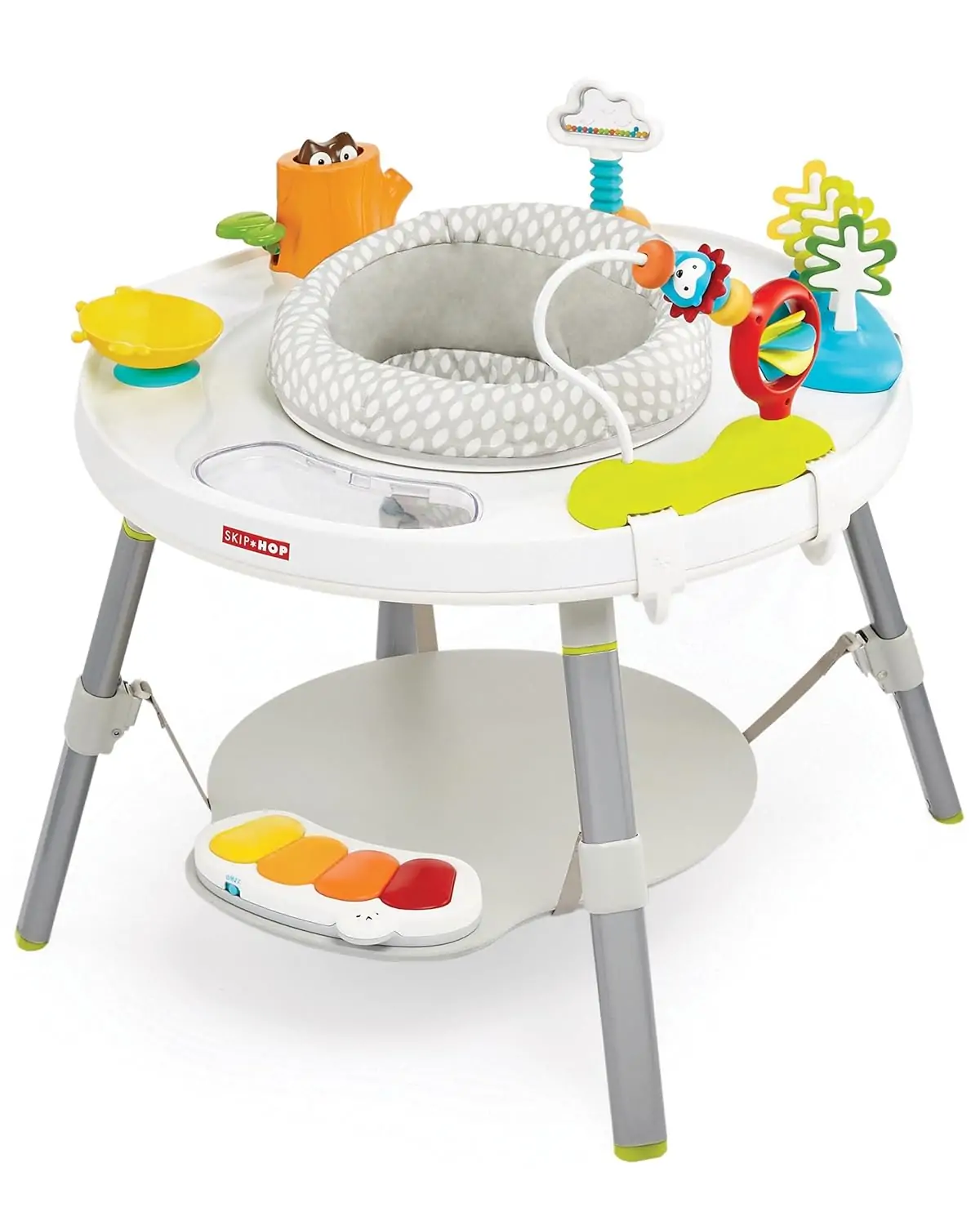
Skip Hop Baby Activity Center: Interactive Play Center with 3-Stage Grow-with-Me Functionality, 4mo+, Explore & More
- 3-stage design grows with baby from seated play to toddler table use
- Discovery Window™ lets baby see the piano and their feet while playing
- 360-degree rotating seat makes toys easy to reach from every angle
- 25+ developmental activities support sensory play and early motor skills
- Musical light-up piano includes piano, song, and motion sensor modes
- Smooth play table conversion extends use into the toddler stage
Support Baby’s Early Play and Learning With a Thoughtfully Designed Activity Center
As babies grow more curious, they need a play space that does more than keep them busy. The Skip Hop Explore & More Baby’s View 3-Stage Activity Center is designed to support that early stage with a full-circle play setup, interactive toys, and a layout that helps babies explore movement, touch, sound, and cause and effect in one place. Its standout Discovery Window, rotating seat, and multi-stage design make it one of the most recognizable and classic Skip Hop activity centers in the collection.
Technical Specifications
- Age: 4 months+
- Weight range: 16 to 25 lb
- Maximum height: 30 in.
- Dimensions: 31 × 31 × 18.5 in.
- Product weight: 15 lb
- Stages: 3
- Activities: 25+
- Seat: 360-degree rotating seat
- Power: 3 AAA batteries required
- Materials: PP, ABS, steel, polyester seat
- Care: Machine-washable seat; dishwasher-safe snack bowl
- Model number: 303325
3-Stage Grow-With-Baby Design
The biggest reason the Skip Hop Explore & More model stands out is its true 3-stage layout. It starts as a seated activity center, shifts into a cruising and interaction stage, and later converts into a toddler play table. Skip Hop presents these stages as sit, swivel and play, cruise and interact, and play table, so the product is built to stay useful beyond the short early baby phase.
In the first stage, the center works like a structured seat-and-play setup for babies who are already able to hold the head upright without help. The 360-degree seat lets the baby turn toward toys from every side, while the Discovery Window helps the baby see the piano and the feet during play. That matters because early learning at this age is strongly tied to reaching, looking, touching, and noticing that an action causes something to happen. CDC milestone guidance for this age range highlights reaching for toys, looking at nearby objects, and using the hands during supported sitting as part of normal early development.
The second stage is where this design separates itself from simpler activity centers. Instead of ending once seated play becomes less interesting, it opens into a cruising setup for babies who want to be more active around the table. That gives the Explore & More a more natural next step as babies move from mostly stationary play toward pulling up, standing with support, and moving around furniture. CDC milestone materials also proved that sitting without support, pulling to stand, standing while holding on, and getting into a sitting position are key physical milestones across the later baby stage, so this transition makes practical sense when used at the right time for the child’s development.
The third stage is not just a leftover tabletop. It becomes a proper play table with a smooth surface, which gives the product a longer life after the seat stage is over. It changes the value of the product in a real way. Many baby activity centers are mainly useful for one window of development, but this one is designed to keep working once the baby has moved on from the seated setup. Skip Hop also sells matching kid chairs for the table stage, which shows that the table conversion is meant to be a real part of the product, not just an afterthought.
From a practical point of view, the 3-stage design helps in two ways. First, it gives parents a clearer progression instead of forcing one setup to fit every stage. Second, it makes the product feel less short-lived. However, the stages should follow the baby’s actual readiness, not just the calendar. Skip Hop’s own use guidance starts with babies who can hold the head upright unassisted, and broader milestone guidance supports watching for real motor signs such as steady sitting, reaching, pulling to stand, and supported standing before moving expectations upward.
Discovery Window
The Discovery Window is one of the details that makes the Explore & More model feel different from many other activity centers. It is the clear opening in the activity center that lets the baby look down and see the piano and their own feet while playing, rather than only the toys placed at eye level. It may sound simple at first, but it changes how the activity center works in a real way. Instead of play happening only with the hands and the upper body, the setup helps the baby notice that movement from the lower body can also create a result. It has always been one of the signature parts of the classic Explore & More design.
Most activity centers surround babies with toys they can bat, grab, or spin, but the lower part of the body often feels passive. The Discovery Window adds a visual connection that many similar models do not emphasize. When babies kick, tap, or shift their legs near the piano area and can actually see what is happening below, the play experience becomes easier to understand. The product is designed around cause and effect. It gives babies a better chance to connect movement with response, which is a big part of how early play starts to feel meaningful rather than random.
The design matters because babies at this stage are learning through repetition. They do something, notice a change, and then do it again. Seeing the feet and the piano at the same time supports that loop more directly than a standard tabletop setup. Research in infant development has long shown that babies begin learning contingency, the link between their own action and an outside response, through repeated sensory feedback and movement. The Discovery Window fits naturally into that kind of learning because it makes the result of movement easier to notice.
It also helps explain why the Explore & More center feels more thought-through than a model that simply adds more toys. The point here is not just stimulation. It is coordinated stimulation. baby is looking, moving, hearing sound from the piano, and gradually understanding that the body can make something happen. That is a more complete type of play, and it fits with Skip Hop’s broader “whole body” approach to this activity center. The Discovery Window is a small design feature on the surface, but it does a lot of work in shaping how the product feels in actual use.
Interactive Toys and Developmental Activities
The Skip Hop Explore & More Baby’s View 3-Stage Activity Center is not built around one standout toy. Its appeal comes from the way the full activity setup works together. The activity center comes with 25+ developmental activities, including a musical light-up piano with three play modes, a peek-a-boo owl that pops out and hoots, a spring cloud with colorful beads, swaying trees, a hedgehog bead mover with spinner, and toy loops with clip-on toys that can be positioned based on baby’s abilities. This mix gives the center more variety than a simpler model that relies on only a few fixed toys around the seat.
What makes this feature work well is that the toys are not all asking babies to do the same thing. Some invite batting, grabbing, and spinning. Some draw attention with sound or movement. The piano adds a stronger cause-and-effect response, while pieces like the beads, spinner, and moving trees support repeated hand play and visual tracking. The design is important because babies at this stage do not interact with everything in one consistent way. They learn through short, repeated actions, and a setup with different kinds of feedback usually holds attention better than one that repeats the same toy function over and over.
The musical light-up piano is one of the best examples of that variety. Skip Hop highlights three ways to play: piano mode, song mode, and motion sensor mode. So the piano is not just there to make noise. It gives the lower play area a more active role and helps connect movement with sound and response. It is especially important on this model because the piano works together with the Discovery Window, giving the baby a better chance to notice what happens when the body moves, kicks, or shifts during play.
Another advantage of this design is that the toy layout is not completely fixed. The clip-on toys on the center can be positioned anywhere based on the baby’s abilities, which gives parents a little more control over how the activity center feels from one stage to the next. A baby who is just starting to reach and grab may do better with toys placed closer and more directly in front, while a more active baby may respond better to a wider spread that encourages turning, stretching, and moving around the seat. It is a small design choice, but it makes the activity setup feel more flexible and less static over time.
Whole-Body Play Design
The whole-body play design is one of the features that gives the Explore & More activity center more depth than a model built around only a few tray toys and a spinning seat. The layout is designed to keep more of the body involved during play, not just the hands and eyes. The seat, surrounding toys, lower piano area, Discovery Window, and adjustable foot support platform all work together, so the activity center feels more connected from top to bottom instead of split into separate play zones.
You may understand the whole-body design better once your baby is in the center. At eye level, there are toys to reach for, bat, grab, spin, and watch. Lower down, the piano and visible foot area give the legs and feet a more active role. The rotating seat adds another layer by letting your baby turn toward different toys instead of staying in one fixed direction. As a result, play feels more active and more balanced, because attention is not limited to one narrow area in front of the body.
This is also part of what makes the Explore & More model feel more thoughtful in daily use. It does not rely on one oversized toy or one flashy sensory effect to hold attention. The experience comes from many small actions working together: reaching across the tray, turning in the seat, looking down through the Discovery Window, tapping the piano, and shifting weight while staying engaged with the toys around the center. That kind of setup creates a fuller play pattern, with movement happening through more than one part of the body at the same time.
The adjustable foot support platform is another important part of that design. A better foot position can help the setup feel more stable and more comfortable, and it also makes the lower play area feel intentional rather than secondary. Together with the Discovery Window and piano section, it helps turn the lower half of the body into part of the play experience instead of leaving it passive.
While many activity centers can keep a baby occupied for a while, the Explore & More is arranged to make play feel more coordinated across the whole body, which gives the product a stronger sense of purpose and helps explain why this classic model still stands out in the industry.
Explore & More Theme
The Explore & More theme gives this activity center much of its charm. Instead of feeling plain or purely functional, the setup creates a small play world around the baby with animals, trees, clouds, and nature-inspired details built into the toy layout. The look is playful without feeling chaotic, which is a big reason this model feels so memorable at first glance. It has personality, but it still keeps the overall design clean enough to work as an everyday baby product.
That theme is carried through the toys themselves. The peek-a-boo owl, spring cloud with colorful beads, swaying trees, and hedgehog bead mover with spinner are not random add-ons. Together, they give the activity center a consistent visual identity, so the product feels designed as one complete concept rather than a tray filled with unrelated toys. Even the bee snack bowl continues that same playful direction.
The theme also helps shape the mood of the play experience. Because the pieces are based on familiar animals and simple outdoor elements, the center feels friendly and easy for parents to recognize at a glance. It does not lean into loud novelty for attention. Instead, it uses a soft, cheerful nature-and-outdoors style that makes the toy area feel lively while still staying visually organized.
This feature matters because the theme is not only about decoration on a product like this. It affects how cohesive the whole activity center feels in daily use. A strong theme makes the toy set easier to understand visually, gives the product a more polished identity, and helps it feel like more than just a collection of developmental features. On the Explore & More model, that playful nature theme is a big reason the design feels so recognizable.
How to Use the Explore & More Skip Hop Activity Center
1. Set Up the Base on a Safe Surface
Start on a flat, level floor with enough space around the activity center for you to move easily during setup and daily use. This model should not be used near stairs, heaters, fireplaces, pools, or other dangerous areas, and the child should always stay in view while in the center. It is designed for a baby who can hold the head up unaided, and use should stop once the child begins walking unassisted, can lift out of the seat, weighs over 25 lb, or is over 30 inches tall.
A practical tip here is to choose the final spot before you assemble it. Once the center is fully set up, it is much easier to use if it already sits in a place where the base is stable, the toys are easy for you to reach, and there is no temptation to slide it around from room to room.
2. Assemble and Lock the Legs First
Attach the four legs to the tabletop and make sure all four are securely locked before placing your baby in the seat. The manual specifically warns to confirm the legs are locked before use.
After the legs are on, press gently on opposite sides of the tabletop to make sure the base feels even and stable. The quick check helps catch a leg that is not fully seated before the rest of the setup is in place.
3. Install the Seat and Check the Rotation
Once the base is stable, install the seat in the center opening. The seat is designed to spin 360 degrees.
Before moving on, give the seat a slow turn by hand. It should rotate smoothly without rubbing or catching. Doing this before you add toys and place your baby inside makes it easier to notice if anything was not fitted properly.
4. Assemble the Platform Under Baby’s Feet
Next, attach the platform under the seat. This part supports the feet and also becomes the place where the piano can be mounted during the activity center stage. The platform height can be adjusted later, but baby must always be removed before you change it. The platform may also be removed once your baby’s feet are flat on it.
A useful tip is to treat foot position as part of the setup, not an afterthought. When your baby is placed in the seat, the legs should look natural and supported, not stretched down awkwardly or left dangling. Checking this early usually makes the activity center more comfortable and helps the lower play area work the way it should.
5. Attach the Toys Around the Table
Install the toys by placing each toy flat on the edge of the table so the clip pushes out, then pushing the clip under the table until it holds securely. The manual also shows how to remove or move toys later by pulling the suction cup tab and pulling the clip from under the table.
Always place the most engaging toys in the spots your baby is most likely to notice first, then spread the others around the table. You do not need to overthink the exact layout on day one. It is usually better to start simple, then move toys later once you see which ones your baby reaches for most often.
6. Install the Piano and Add Batteries
The piano can be mounted on either the table or the lower platform. To install it, insert the back of the piano into the slot first, then press down on the front. It requires three AAA batteries, which should be installed by an adult using a screwdriver. When mounted to the lower platform, movement activates the music, and each key also plays a different song.
It helps to test the piano before putting your baby in the seat. That way, you can confirm the batteries are working and the piano is fully seated. If you plan to store the toy for a while, removing the batteries is the better way to preserve battery life.
7. Place Baby in the Seat and Check the Fit
After assembly, place your baby in the seat and do one full fit check before play starts. Your baby should be well supported, able to turn comfortably, and able to reach nearby toys without straining. The feet should rest naturally on the platform. If the fit looks off, remove your baby first, then adjust the platform height as needed.
A simple tip is to watch the first few minutes instead of assuming the setup is right just because assembly is finished. If your baby seems cramped, sits unevenly, or cannot engage the toys comfortably, the problem is often the fit or toy placement, not the product itself.
8. Use It for Daily Play
Once everything is assembled and the fit looks right, baby can turn in the seat, reach for the toys, and interact with the piano and lower play area. Keep the child in view the whole time, and inspect the activity center before each use. If any part shows damage or weakness, stop using it.
For daily use, a quick routine helps. Check the legs, glance at the toy clips, make sure the piano still sits securely, and look at the platform height before placing your baby inside. Those small checks take very little time and help prevent most common setup problems.
9. Change the Setup as Baby Grows
As your child grows, the setup can be adjusted instead of left in the same arrangement. You can move or remove toys, adjust the platform height, and later remove the seat and toys from the table for the play table stage. When the seat is not in use, the straps should be clipped to the bottom of the platform as shown in the instructions.
Also, not to wait until your baby clearly dislikes the current stage. If you notice more interest in standing, cruising around the outside, or using the surface more like a table than a seat-based toy center, that is usually the right time to look at the next setup.
How to Clean the Explore & More Skip Hop Activity Center
Clean the Plastic Parts Regularly
The plastic parts, including the tabletop, frame, platform, and the surfaces around the toy area, should be wiped with mild soap and water, then left to air dry. Because this activity center gets touched constantly during normal play, quick wipe-downs usually work better than waiting until everything looks dirty. For most families, the easiest routine is to wipe the main plastic surfaces often during the week and do a more careful clean around the toy area whenever you notice buildup.
Wash the Seat Cover When It Starts to Look Soiled
The fabric seat cover can go in the washing machine on a cold, gentle cycle. It should not be bleached, ironed, or dry cleaned, and it should be dried flat. This is the part that usually needs deeper cleaning after spit-up, drool, or longer daily use, but it does not need to be washed after every single session. A more practical way is to wash it whenever it starts to look noticeably dirty or after messier days.
Wash the Bee Bowl After Each Use
The bee bowl needs a different cleaning routine from the rest of the center. It should be washed thoroughly before first use and after each use, and it is dishwasher safe on the top rack only. Since this part comes into direct contact with food, it should be cleaned as soon as possible after snacking rather than left with residue sitting on it.
This is one of the easiest maintenance habits to keep up with. If the bowl is used daily, treat it like any other feeding item instead of part of the larger play center. That usually means far more frequent cleaning than the tray, frame, or toys.
Remove Toys If You Want a More Thorough Clean
If you want to clean the tabletop more thoroughly, remove the toys first. The toy system is designed to be attached and removed from the table edge, which makes it much easier to wipe the spots where crumbs, dust, or dried residue collect around the clips and attachment points.
A practical way to do this is not to pull everything off every day. For routine care, a quick wipe around the toys is usually enough. For a deeper clean, remove a few toys at a time, clean the table edge properly, wipe the toy surfaces, let everything dry, and then put them back.
Keep the Piano Clean and Dry
The piano should be handled more carefully than the washable parts because it contains batteries and electronic components. It requires 3 AAA batteries, and the battery compartment is opened and closed with a screwdriver. Since the instructions also recommend removing the batteries during storage to prolong product life, it makes sense to keep this part dry and avoid treating it like a washable toy.
In daily use, the safest approach is to wipe the piano surface gently and avoid getting moisture into the battery area. If you are doing a bigger cleanup or putting the center away for a while, removing the batteries first is the better habit.
Let Everything Dry Before Putting It Back Together
After cleaning, let all parts dry fully before reassembly. It’s very important for the seat cover, tabletop, toy area, and any part your baby touches often during play. Reassembling too quickly can make the center feel damp or undo the work you just did.
How Often to Clean It
There is no one fixed cleaning schedule for every family, but the instructions make it clear that the bee bowl should be cleaned after each use, while the plastic parts and fabric parts should be cleaned with the methods given above. In practice, that usually works best as a layered routine: quick wipe-downs for the plastic surfaces on a regular basis, more thorough cleaning around toys and attachment points as needed, and machine washing the seat cover whenever it becomes soiled.
If your baby uses the activity center every day, a simple routine works well: wipe the main surfaces often, wash the bowl every time it is used for snacks, and keep an eye on the seat cover and toy area so you can clean them before mess builds up too much.
Maintenance Tips for Everyday Use
Good maintenance is not only about cleaning. Before each use, the product should be inspected, and it should be thrown away or discontinued at the first sign of damage or weakness. The legs should remain securely locked, the toy attachments should stay firmly in place, and the piano should stay seated correctly. The activity center should also not be used if it is damaged or broken.
It also helps to watch how the setup is fitting your baby over time. The platform height may need adjustment as your child grows, and those adjustments should always be done with the baby out of the center. The platform may also be removed once the feet are flat on it.
Troubleshooting the Explore & More Skip Hop Activity Center
Issue 1: The Activity Center Feels Unstable
If the activity center does not feel steady, stop using it and check the base first. Make sure all four legs are fully locked and that the center is sitting on a flat, level floor. If one side feels uneven after assembly, the problem is often in the leg connection rather than the seat or toy area. Resetting the leg fit before using it again is the safest first step.
Issue 2: The Seat Does Not Spin Smoothly
The seat should rotate smoothly, so if it feels tight, catches, or does not turn the way it should, check the seat fit in the center opening and make sure nothing around it is getting in the way. A simple way to test this is to turn the empty seat slowly by hand before placing baby inside. If it still does not move cleanly, something likely needs to be repositioned before daily use.
Issue 3: Baby’s Feet Do Not Reach the Platform Properly
The right platform setting is based on fit, not just age. The balls of baby’s feet should be able to reach the platform comfortably. If the legs look stretched, unsupported, or awkward, the platform height likely needs adjustment. This is one of the most important setup checks because the activity center works best when baby’s lower body is properly supported.
Issue 4: You Are Not Sure Whether Baby Is Ready to Use It
This model is for a child who can hold the head upright unassisted. It should not be used for children over 25 lb or over 30 inches, and use should stop once a child begins walking unassisted or can lift out of the seat. That gives you a much more reliable guide than age alone. If the baby does not yet have that level of head control, it is too early to start.
Issue 5: The Piano Is Not Working
If the piano stops working, start with the batteries. This is the first practical step and also the most common one. If replacing the batteries does not solve the problem, the next step is to contact Corporate Consumer Affairs at 888.782.9548 and select option 4, or email [email protected]. Parents have also asked about buying a replacement piano, but standard replacement parts are not generally sold separately for this product.
Issue 6: The Piano Volume Is Very Low
This model does not include a volume adjustment setting. If the piano becomes very quiet, the recommended first fix is to replace the batteries. If the sound still seems unusually low after that, the issue should be taken to Corporate Consumer Affairs rather than treated as a simple setting problem.
Issue 7: You Need a Replacement Part
This is one of the most useful things to know before you run into a problem. Replacement parts are generally not sold separately for this activity center. That includes parts such as the seat, fabric, platform cords, and extra clip-on toys. If a part is broken, the practical next step is to contact Corporate Consumer Affairs rather than spending time looking for an official parts page that may not exist for this model.
Issue 8: You Want Extra Clip-On Toys
Additional clip-on toys are not sold separately. So if one is lost or if you hoped to expand the toy set later, that is not something typically offered as a standard accessory for this activity center.
Issue 9: You Need to Clean Around the Discovery Window Seam
The Discovery Window is not removable. If dirt collects around the seam, the recommended way to clean it is with a Q-tip and warm soapy water. This is one of the more specific maintenance details for this model, and it is worth knowing because the clear window area can be harder to clean than the open tray surfaces.
Issue 10: Marks or Crayon Are Stuck on the Table Surface
For marks on the gray table surface, the recommended cleaning method is a damp cloth and mild soap. That is the safer approach for this product surface and a better first step than trying stronger household cleaners.
Issue 11: You Are Converting It to the Table Stage and Expect Chairs to Be Included
The matching chairs are sold separately. This is easy to miss when parents start thinking ahead to the play table stage, so it helps to know before making that transition.
Issue 12: You Need to Remove the Seat Cover for Washing
The seat cover is removable, but the official guidance for the removal steps points back to the instruction manual. So if you are taking it off for cleaning, it is better to follow the manual directly rather than guess the removal sequence. That helps avoid unnecessary pulling or strain on the seat fabric and attachment points.
What Parents Say About the Explore & More Skip Hop Activity Center
A lot of families end up loving this Explore & More activity center because it gives their baby a place to stay busy for a while without seeming bored or fussy right away. Parents describe babies spinning from toy to toy, reaching for different parts around the circle, and staying interested longer than expected. More than one person said it became the one baby item that truly worked when other seats or bouncers did not. A few even called it a lifesaver because it finally gave them a little time to wash dishes, do chores, or get through part of the day with both hands free.
Some parents bought it for their own child, then later bought the same one again as a gift. Some grandparents liked it enough to keep one at their own house for visits. One family said they had used it through multiple children and were still getting use out of it years later. Another said they first thought the price felt high, then changed their mind after seeing how much use they got from it. Those stories say more than a simple star rating ever could.
The way babies move in it seems to be a big part of why it works so well. Parents often mention that their baby likes turning all the way around, moving from one toy to the next, and staying upright while exploring. Some babies seemed especially happy just being able to stand more upright and look around, while others were drawn in by the toy variety, the spinning pieces, and the piano area. Several parents also mention that the toy setup feels engaging without looking too loud or too cluttered, which is something many parents appreciate when this kind of product is sitting in the middle of the room every day.
People also speak well of how sturdy it feels. Parents describe it as stable, solid, and well made, and some specifically like the leg design because it feels steadier than flimsier saucer-style activity centers. Easy setup comes up a lot too. Quite a few buyers said it was quick to put together, easy to move from room to room, and simple to keep in regular use. The seat cover being washable and the toys being removable also made a good impression on families who were already thinking about cleanup from the start.
Longer use is another reason people feel good about it. Parents like that it does not feel finished after one short baby stage. Some mention using it first as an activity center, then later as a play table. One person said it became an art table for a toddler and was still holding up years later.
However, a few parents did run into piano problems, either because it did not work from the start or later stopped working. Some were frustrated when a favorite toy broke and they found out replacement toys or parts were not easy to get, including a cloud or spinner toy, a missing seat, or worn pieces. The yellow bowl also got called out by one parent for being easier to knock off than the clipped toys. There were also isolated complaints about damage on arrival, a child getting a cut near the tree area, and mold being found around the clear tray area after longer use.
Timing also seems to matter. Some babies loved it right away, while others really got into it a little later, once they had better body control and more interest in the toys. So even when parents liked the product itself, a few felt that actual enjoyment depended a lot on the baby’s stage, not just the age printed on the box.
Our Unboxing Experience
Unboxing the Skip Hop Explore & More 3-Stage Activity Center felt easier than we had expected at first. Once everything was taken out and spread across the floor, the setup started to make sense pretty quickly. Inside the box were the main tabletop, four legs, the seat, the lower foot platform, the piano, the toys, the snack bowl, and the table insert for later use. There were also instruction sheets included.
At first, it did look like a lot of pieces. It helps to take everything out and group similar parts together before starting. Once the larger pieces were separated from the smaller boxes, the whole layout felt much more manageable. The tabletop is the main piece, and after that, the rest of the setup follows a pretty clear order.
The legs were one of the first things to assemble, and this part was simple once the pieces were lined up correctly. The height settings were easy to notice right away, which helped make the structure feel less confusing. The lower platform also stood out during setup because it does two jobs at once. It supports the baby’s feet, and it also holds the piano in the seated stage. The clear window area underneath was another detail that was easy to notice early on.
The toys are packed separately, so this unboxing feels more hands-on than opening a toy that comes mostly assembled. That actually works in its favor, because it makes it easier to see how each piece fits into the finished center. Once the toys were out, it was clear that they were meant to be clipped around the table in different spots instead of staying in one fixed layout.
The piano was one of the parts that needed a little more attention. It can be placed in different positions, so there is some flexibility there. Batteries are part of the setup too, and they are not included, so a screwdriver and the right battery size need to be ready before the piano can be tested.
One of the first practical things you notice is that the height may need adjusting once your baby is in the seat. That is normal, because it is much easier to judge the fit when you can see where your baby’s feet land and whether the platform is sitting at the right level.
Once everything was put together, the activity center felt much less complicated than it did at the start. The separate pieces made more sense once the legs were in, the toys were clipped on, and the piano was in place. There were still a few small things to adjust, especially the height once baby was sitting in it, but the overall setup felt pretty straightforward. By the end, it looked like a complete play space rather than a box full of separate parts.
Pros
- 3-stage design gives it a longer usable life than many baby-only activity centers
- Discovery Window and piano setup make foot play more interactive and easier for baby to notice
- 360-degree seat makes it easy for baby to turn from toy to toy
- Toy layout feels varied and engaging for many babies
- Toys can be moved around, which adds some flexibility as baby grows
- Adjustable platform helps with foot positioning
- Sturdy overall build is one of the most common positives in user feedback
- Easy assembly is mentioned often by parents
- Seat cover is removable and washable
- Converts into a play table for later use
Cons
- Replacement parts are generally not sold separately
- Extra clip-on toys are not sold separately
- Yellow snack bowl may not stay in place as securely as the clipped toys
- Discovery Window area is harder to clean than open surfaces
- Batteries are not included for the piano
Conclusion
The Skip Hop Explore & More Activity Center has stayed popular for a reason. It is one of those baby products that feels simple at first, but once you look closer, there is a lot built into it. From the overall layout to the small details that shape how babies interact with it, this is a baby product that was clearly designed to be used, adjusted, and lived with over time.
For parents trying to decide whether it is the right fit, the real question is not whether it has enough toys or enough features on paper. It is whether this kind of center design matches the stage your baby is in now, the way your home works, and the kind of use you want to get from it over the months ahead.